

Problem
Schools and journals started policing AI writing with detectors
After ChatGPT, instructors and reviewers began running text through AI detectors, and those scores can carry real consequences for students and authors. We asked how well the detectors people actually use can tell human from AI writing in our own research field.
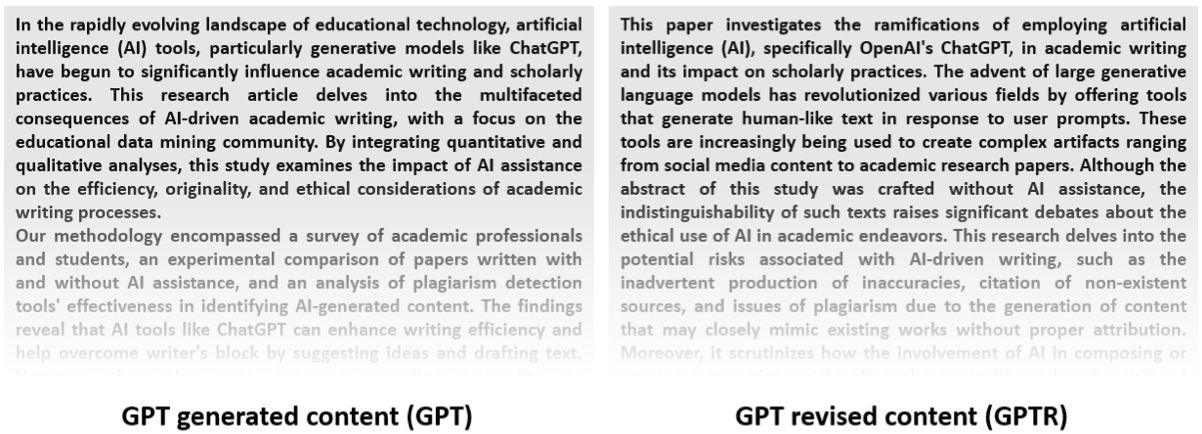
The title is literal. We disclosed in the paper that GPT-4 Turbo helped write and revise parts of it, and shared our data openly, as a working example of disclosure instead of detection.
Approach
Build a test where the answer is known
- A known-human baselineTitles and abstracts of all 241 papers from EDM 2022 and LAK 2022, submitted before ChatGPT was public.
- Five realistic conditionsThe human original; ChatGPT writing from the title alone; ChatGPT polishing the human abstract; and half-human, half-AI mixes in both orders.
- Detectors people really useChosen by search ranking, ease of use, and API access, including free tools common in underfunded schools: ContentDetector.AI, ZeroGPT, GPTZero, Originality.ai, Winston.ai.
- MetricsRMSE against the known answer, and AUC for how well each detector separates human, polished, and AI-written text.
Try it
Same abstracts, five verdicts
Pick a version of the abstracts and see what each detector says, on average, across the 123 LAK 2022 papers.
Ground truthWritten by a person, reworded by AI
Same abstracts, five detectors: 2% to 94% “AI.”
Findings
Inconsistent on humans, blind to mixes, harsh on polish
- Detectors disagree on human writingOn purely human abstracts, average “AI” scores ranged from 7% to 47% depending on the tool.
- Polishing reads as cheatingOriginality.ai, the strongest at spotting pure AI text (95%), gave human abstracts that ChatGPT only polished 94%. Polishing is common practice for non-native English writers.
- Free tools miss AI textZeroGPT averaged about 1% on abstracts ChatGPT wrote from scratch.
- Mixed text reads as humanOn half-AI abstracts, detectors erred least when we assumed only 36–40% AI, so they systematically underestimate how much was generated.
Impact
What this means for anyone judging authorship
- Never rely on one scoreDetectors contradict each other on the same text. A single score is not evidence of misconduct.
- Watch who gets flaggedWriters who polish their own work with AI, often non-native English speakers, are the most likely to be flagged.
- Prefer disclosureOpen data and plain statements of how AI was used answer the question detectors cannot.
Detectors change monthly, so these numbers are a snapshot from early 2024, on abstracts from two conferences. Next I would test full papers and student essays, and study the human side: how instructors read a detector score and what they decide to do with it.