

Problem
AI can write a lesson plan in seconds. That is the problem.
AI tools now produce complete instructional materials that look competent, are often thin on pedagogy, and say nothing about why. When AI writes everything, the educator’s job shrinks to approving it.
We wanted the opposite: AI that widens an educator’s options while the educator stays the decision-maker, grounded in Bloom’s taxonomy so every suggestion can be checked against a framework teachers already use.
Design
Separate the AI that writes from the AI that checks
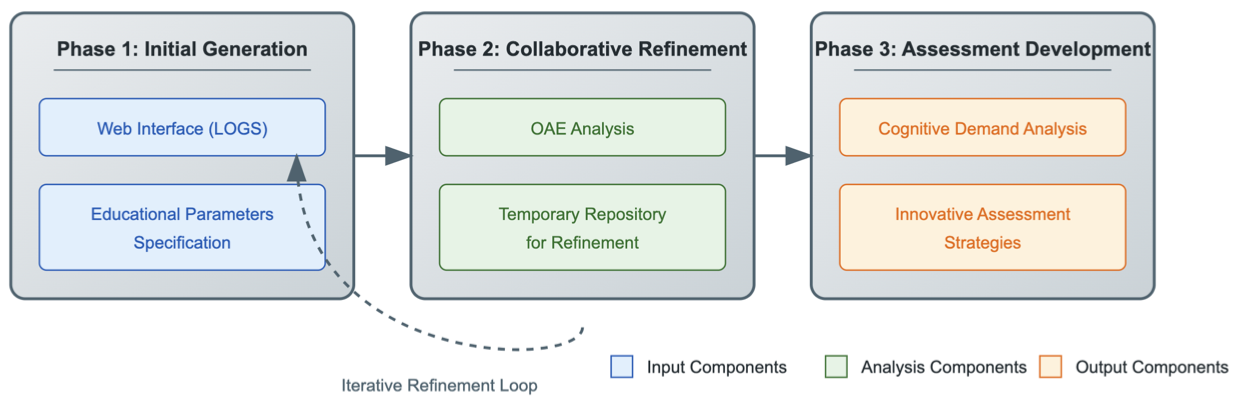
ARCHED (AI for Responsible, Collaborative, Human-centered Education Instructional Design) is the framework; LOGEN AI is the public tool that implements it. Its three phases are shown at the top of this page: generate, refine, then build assessments, with the educator able to loop back at any point. The core move is splitting the AI in two, and giving every decision to the educator:
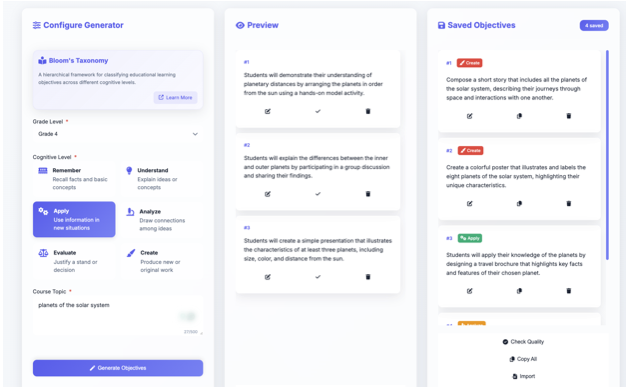
- The educator sets the frameGrade level, subject, and the cognitive level they want, before anything is generated.
- A generator proposesThree to five candidate objectives, never a final set.
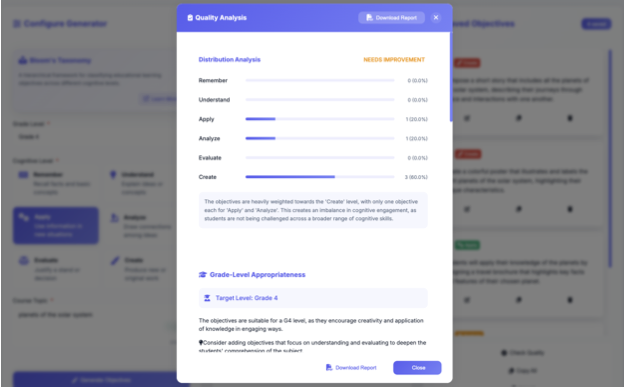
- An evaluator explainsA separate agent classifies each objective’s cognitive level, scores measurability and clarity, and says why.
- The educator curatesEdit, keep, or discard each one. Nothing is saved without an explicit choice.
Evaluation
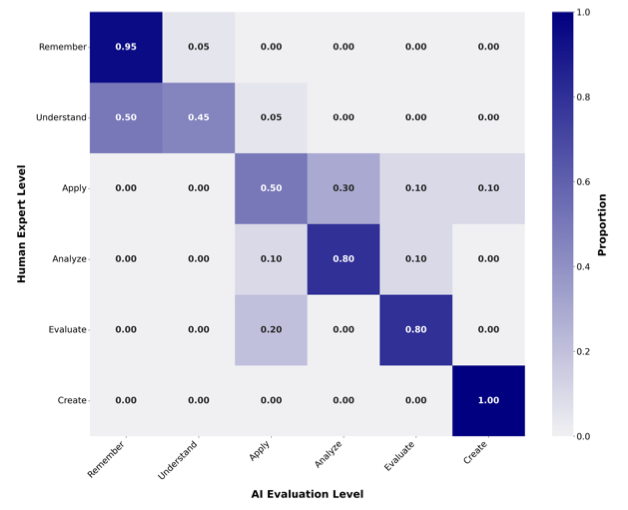
Is the evaluator right, and is the output good enough?
Most disagreements were between adjacent levels in the middle of the taxonomy, the same places human experts disagree.
“Having the freedom to select which objectives align with student needs and course goals, rather than accepting all generated content, helps maintain instructional control while leveraging AI assistance.”Instructional design expert, pilot feedback
Impact
From framework to a public tool
LOGEN AI is live at logen.viablelab.org with a tutorial video. Later versions let educators edit an objective directly inside the quality report, with a prompt to re-check it, and rebuild reports only when objectives change. One request is still open: experts asked for integration with learning management systems.
Reach
A workshop paper that became a reference point
ARCHED was a spotlight paper at a AAAI 2025 workshop. Within a year and a half, people outside our lab started using the name itself, not just citing the paper: an international policy report explains it, a textbook assigns it, and newer frameworks define themselves against it.
- Mar 2025
- May 2025Online Learning Consortium ↗Professional body
Its AI Course Compass framework names “existing frameworks like OLC’s AI Strategy, ETHICAL Principles, and ARCHED” and defines what it adds beyond them. Republished by Texas A&M–Corpus Christi.
- Jun 2025Interactive AI Magazine (AAAI) ↗Professional body
The AAAI 2025 workshop report picks ARCHED as its example of human-AI collaboration in instructional design.
- Aug 2025Worcester Polytechnic InstituteVenue
Invited guest lecture on ARCHED for the graduate User Modeling course.
- Jan 2026OECD Digital Education Outlook 2026 ↗Policy report
Chapter 3 gives ARCHED its own box (Box 3.1), explains the generator and analysis engine, and returns to it on transparency, human oversight, and future teacher authoring tools.
- 2026Routledge, Streamlined ID (textbook) ↗Textbook
Listed as a chapter resource in two chapters of an instructional design textbook.
- Jul 2026Discover Artificial Intelligence (Springer) ↗Scholarship
A new framework, ALT-ED, positions itself as the run-time complement to ARCHED’s design-time workflow and compares the two directly.
Two expert reviewers and one evaluator make a pilot, not proof. Next: a study with practicing teachers on their own courses, measuring how often they keep, edit, or discard AI objectives, and whether the evaluator’s explanations change their choices. I would also remove a choice I made: the quality check shows four progress stages for what is really two model calls. It looks thorough, but it is not honest.