

An experienced educator
Reads the AI’s draft, spots what is off, keeps what fits. The judgment was there before the tool, and the tool saves time.



AECT 2026 · Emerging Learning Technologies · Chicago
LOGEN AI helps educators who can already judge a learning objective. People still building that judgment need something else. Class-Ready keeps the same AI judge and takes away its pen: learners write, judge their own work first, and answer questions, while instructors see how the thinking grew. This page follows that story from our 2025 system to the version live today, including what a full walkthrough exposed.
Generative AI can write a strong learning objective in seconds. That helps when you already know what a strong one looks like. It gets in the way when learning to write one is the point of the assignment.
At AECT 2025 we presented LOGEN AI, an instructional design tool built on the ARCHED framework. AI generates, refines, and reviews learning objectives. The educator decides what to keep. For someone with a trained eye, that is real help with the judgment left where it belongs.
Reads the AI’s draft, spots what is off, keeps what fits. The judgment was there before the tool, and the tool saves time.
Sees a polished sentence and has no way to tell whether it is right. Accepting it finishes the assignment and skips the skill the assignment is for.
A human in the loop protects judgment only when the human already has it. So we changed the question: how can AI support learners in developing judgment without replacing it?
Large language models can act as evaluators as well as writers, the idea behind LLM-as-a-judge. Class-Ready uses the same review as LOGEN Studio: Bloom level, S·M·A·R·T, fit for the learners. What differs is what the AI may do with its judgment. Switch between the two below.
A draft objective“Students will do a worksheet on fractions using fraction strips.”
Completing a worksheet is an activity, and the fraction skill or evidence being assessed is not identified.
What fraction task would students complete with the strips, and what response would show their reasoning?
No sentence to copy. The next version of this objective has to come from the learner, and the server refuses to write it for them.
| LOGEN Studio | Class-Ready | |
|---|---|---|
| Generate and refine | Yes | Never in class work, enforced on the server |
| Review | Rewrites with one-click apply | Judgments, the main gap, one guiding question |
| Who sees the work | The educator | The learner and the class instructor |
| Evidence | The final objectives | The process that produced them |
The learner judges first and AI asks second. The loop repeats until the learner chooses to submit, and the instructor takes it from there. Choose any step.
Before any feedback, the learner picks the Bloom level and the S·M·A·R·T criteria each ready objective meets. The judge never sees this check.
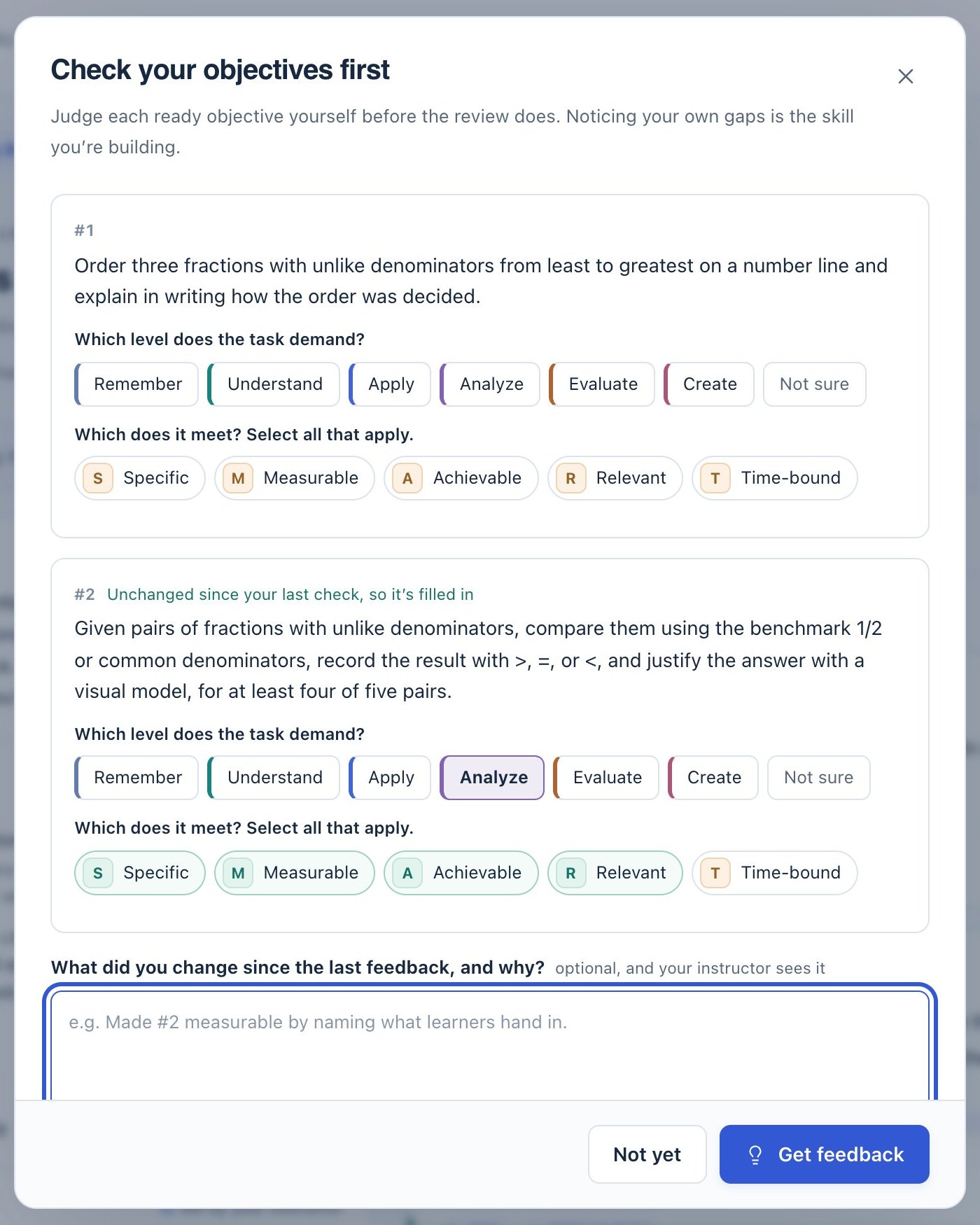
Our AECT proposal described a stand-alone prototype, and its figures show that version. Three rounds of development with experts followed, and we shipped the result as a public, production system inside LOGEN.
| In the proposal | Live today |
|---|---|
| A stand-alone app for pre-service teachers | A mode inside LOGEN, using the same judge. Learner status comes from joining a class, and anyone can create one. |
| AI offers concrete suggestions for revision | AI names the main gap and asks one question. The server refuses to write objectives in class work. |
| The learner submits, then AI evaluates | The learner judges level and S·M·A·R·T first, before every round. The judge never sees that check. |
| No instructor in the picture | Instructors create classes, read the process, grade with a rubric, and release grades when ready. |
| Exactly two Common Core standards | The instructor sets them, learners choose them, or the assignment goes without. Custom standards are welcome. |
| Formatted text to copy into Canvas | A receipt link that opens the submission and how it took shape. |
Class-Ready is public and free. Any account can learn in one class and teach another.
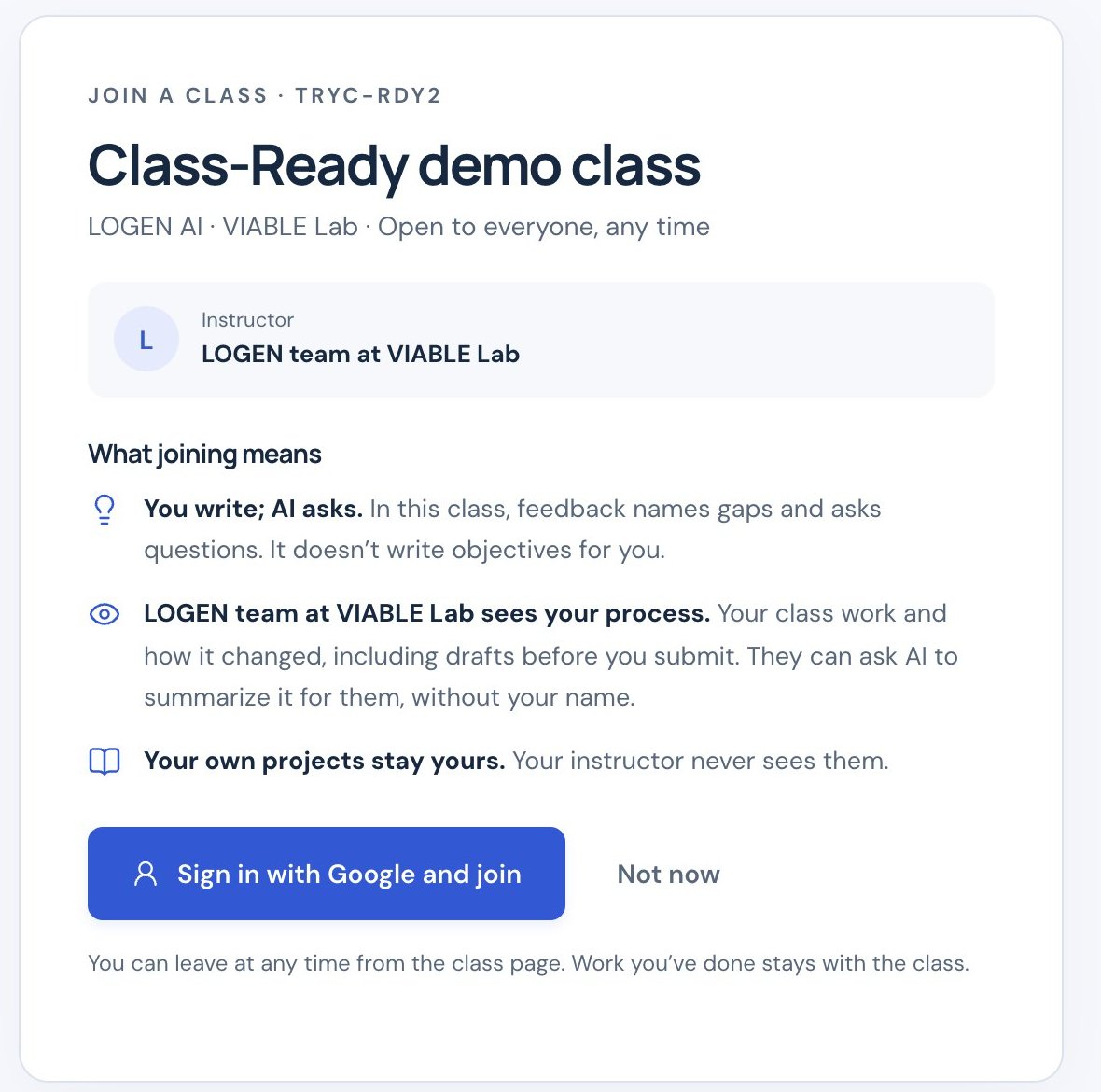
Open Class-Ready and choose Try the open demo class. No code needed. Sign in with Google, write an objective, check it yourself, and read the feedback.
Sign in and open Classes in the left sidebar. Create a class, set an assignment, and share the code. Try it yourself walks you through your own assignment without counting toward the class.
Screens below come from a test class.
We recruited three participants to run the whole workflow end to end in a real browser against the live review model. They thought aloud through 33 tasks, rated them, and completed a semi-structured interview. Between them they joined, wrote, revised, submitted, taught, graded, and closed out a term.
Of the 33 tasks, 25 succeeded, 2 needed extra effort, 6 were partly done, and none failed. We checked the main findings against the code, the stored data, and the screenshots. The participant ratings and interviews identify broken labels, contradictions, misleading numbers, and questions for a larger study; three participants do not establish learning outcomes.
The AI asked, and it never wrote.
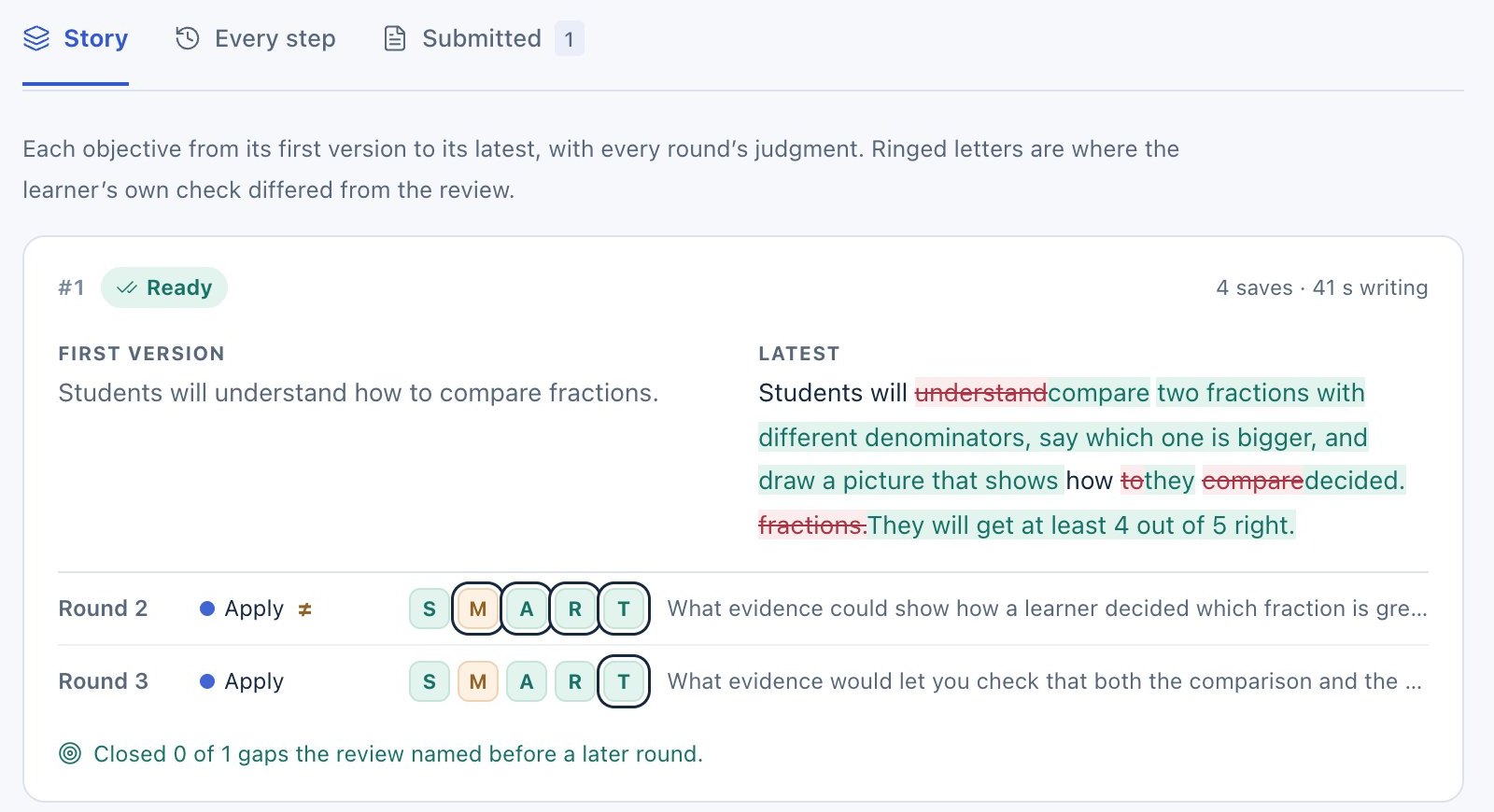
Across 26 reviews the AI wrote no objectives. Below is one participant’s work exactly as stored, round by round: a draft, a question, and what came next. Watch objective #4 in rounds 2 and 3.
#2 Students will learn about ordering fractions from least to greatest.
The objective names a topic rather than one observable learner action and its evidence.
Ask yourselfWhat could a learner do or show that would demonstrate they can order fractions?
#3 Students will do a worksheet on fractions using fraction strips.
Completing a worksheet is an activity, and the fraction skill or evidence being assessed is not identified.
Ask yourselfWhat fraction task would students complete with the strips, and what response would show their reasoning?
| Round | Agreement | Specific and Measurable granted |
|---|---|---|
| 1 | 58% | 0% |
| 2 | 13% | 25% |
| 3 | 83% | 63% |
The AI never writes or rewrites the objective for the student, and the student judges their own work before seeing feedback.
Renee, instructional designer
Agreement with AI is not judgment.
Look again at the chart above. In round 2 the writing got better and the agreement score fell to 13%, then climbed to 83%. The score counts the Bloom level and five criteria equally, and the review almost always grants three of those criteria. Try it: change only the self-check on this round and watch the score.
Students will compare two fractions with different denominators and say which one is bigger.
You Analyze · Review Apply
Students will put fractions in order from least to greatest and show how they got it.
You Apply · Review Apply
Students will use fraction strips to compare two fractions on a worksheet and write why one is bigger.
You Understand · Review Apply
Students will use the symbols >, =, and < to show which fraction is bigger.
You Remember · Review Apply
How often the review granted each criterion, across all 26 reviews
Achievable, Relevant, and Time-bound were granted 77 of 78 times, so a learner earns half of each objective’s score by ticking them. The default rubric then pays for it: “Self-checks come to agree with the review” is worth 2 of 10 points. What that measures is how well a learner predicts the AI.
That 13% was the one moment I wanted to quit, and it wasn’t even measuring my writing.
Jordan, pre-service teacher
The AI read marked down the learner who kept thinking.
During the learner task, the participant’s round 3 note asked, “I’m not sure if the others need a number too.” Then the participant added one to each objective and submitted, with no further review. When a participant in the instructor role asked for an AI read, it said those objectives lacked a threshold. Pick an objective to compare.
Students will compare two fractions with different denominators, say which one is bigger, and draw a picture that shows how they decided.
Students will compare two fractions with different denominators, say which one is bigger, and draw a picture that shows how they decided. They will get at least 4 out of 5 right.
“Review #1–#3 for measurable success criteria: each specifies an observable task but lacks a clear accuracy threshold.”
| Rubric row | AI suggested | Participant rating, after reading the record |
|---|---|---|
| Final objectives 4 pts | Developing 2.7 | Proficient 4 |
| Use of feedback 2 pts | Developing 1.3 | Proficient 2 |
| Judging their own work 1 pts | Beginning 0.3 | Developing 0.7 |
| Reasoning about changes 3 pts | Developing 2 | Proficient 3 |
| Total of 10 | 6.3 | 9.7 |
The read received the submitted wording followed by each round’s old verdicts, with nothing saying the wording had changed. A learner who keeps revising after the last round is marked down for it. The process record is what made the error visible.
Right now the tool’s own summary penalizes the student who goes on thinking without paying for another round, and that undermines the entire promise of seeing the process.
Renee, instructional designer
Summaries can say more than the record.
That is the number of fourth graders in the assignment brief. The test class had two learner participants.
The class read described one learner as “essentially unchanged and stuck.” The unchanged work and the stuck work belonged to different participants.
The overview flagged the participant who changed the most as stuck, because the label also relies on the last reviewed version.
Someone who retypes AI text shows 0% pasted and a green tag. The caution sat in a tooltip, and the risk falls on second-language writers who draft with help.
The participants trusted what they could trace.
Renee and Min-seo ranked the system the same way, from most to least trusted: the log and diffs, the written feedback, the summary figures, then AI reads. Jordan, who never saw a read, trusted the written feedback and not the numbers. All three named the question-based feedback and the self-check as what must not change. With three participants, the ratings are descriptive rather than statistically generalizable. They help compare tasks and point to where to look.
A nervous, time-poor novice who writes “Students will understand” and has lost points without knowing why. Learner in one class.
Next term Would recommend it to classmates for a class that assigns it. Wouldn’t use it alone while AI is paused for student teaching.
That’s the first time anybody explained why ‘do a worksheet’ isn’t an objective, and it did it by asking me a question.
Jordan, pre-service teacher
It told me the one thing I actually keep getting wrong, and it’s the first feedback I could carry to my next lesson plan.
Jordan, pre-service teacher
I finally get what “measurable” means, and I’d use that on my next lesson plan, but some of the numbers didn’t help.
Jordan, pre-service teacher
We took AI out of the writing. It came back through the measurement.
Feedback serves learning when it moves the next attempt forward. Asking keeps that attempt with the learner.
Formative assessment · Black & Wiliam, 1998
What changes Keep the question on screen while the learner revises, which is when it matters most.
The diff and the timeline are what caught the AI read’s mistake. Any AI claim about a learner should sit next to the evidence that can test it.
Feedback literacy · Carless & Boud, 2018
What changes Tell AI reads when objectives changed after the last review, and hold those learners back from bulk grading.
Self-regulation means judging your own work against a standard you understand. Coming to agree with a model is a different thing.
Self-regulated learning · Nicol & Macfarlane-Dick, 2006
What changes Let learners mark “I disagree because…” and credit the reasoning. Show the rubric from the start.
The questions we most want answered:
The goal isn’t a better AI judge of students. It’s students who judge their own work better.