Reads the draft, spots what’s off, keeps what fits. AI saves time.
AECT 2026 · Emerging Learning Technologies
Don’t Write It
For Me
Moving AI from writing learning objectives to judging them, and what that exposed.
1 VIABLE Lab, University of Florida
2 Johns Hopkins University
Scan to follow along
The slides, the demo, and the dataStart with a draft
AI can write a strong objective in seconds.
“Students will understand how to compare fractions.”
“Given pairs of fractions with unlike denominators, compare them using benchmarks and justify the result with a visual model.”
Last year at AECT
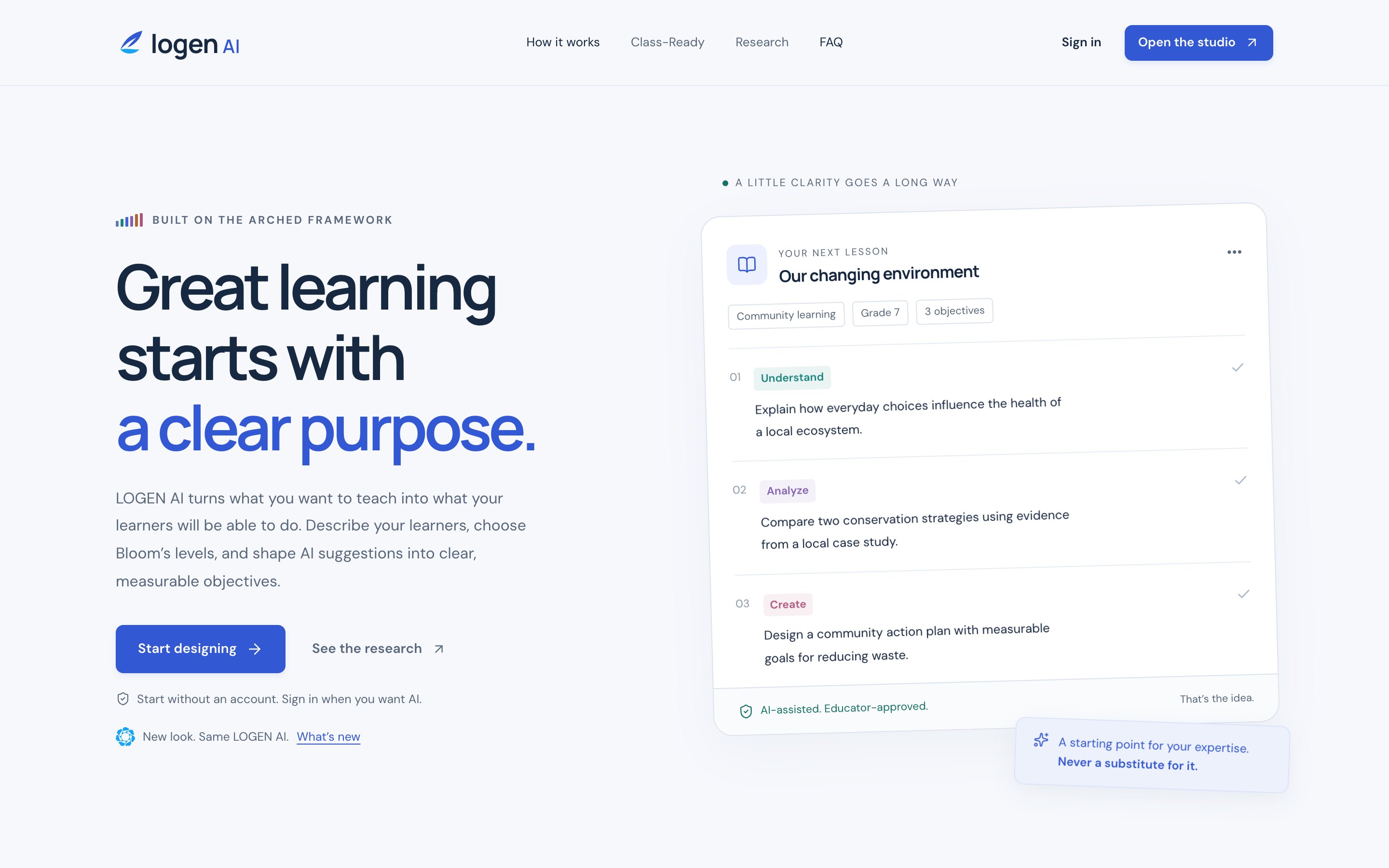
LOGEN AI: the AI suggests, the educator decides.
Built on our ARCHED framework. AI generates, refines, and reviews. The educator keeps the call.

The catch
That design assumes the person in the loop can already judge.
Can’t yet tell strong from polished. AI’s call becomes theirs.
How can AI build judgment without replacing it?
Same judge. Different policy.
The learning loop
The learner judges first. AI asks second.
In their own words, with no AI.
Level and S·M·A·R·T, before any feedback.
A gap and one question.
And say what changed, then go again.
With an explanation and a receipt.
Since our proposal
Three rounds with experts changed what we built.

Try it with me
Scan this, or open the link.
logen.viablelab.org/class-ready- Choose Try the open demo class
- Sign in with Google
- Write one objective, then get feedback
What a learner goes through
A hint, a self-check, then a question.
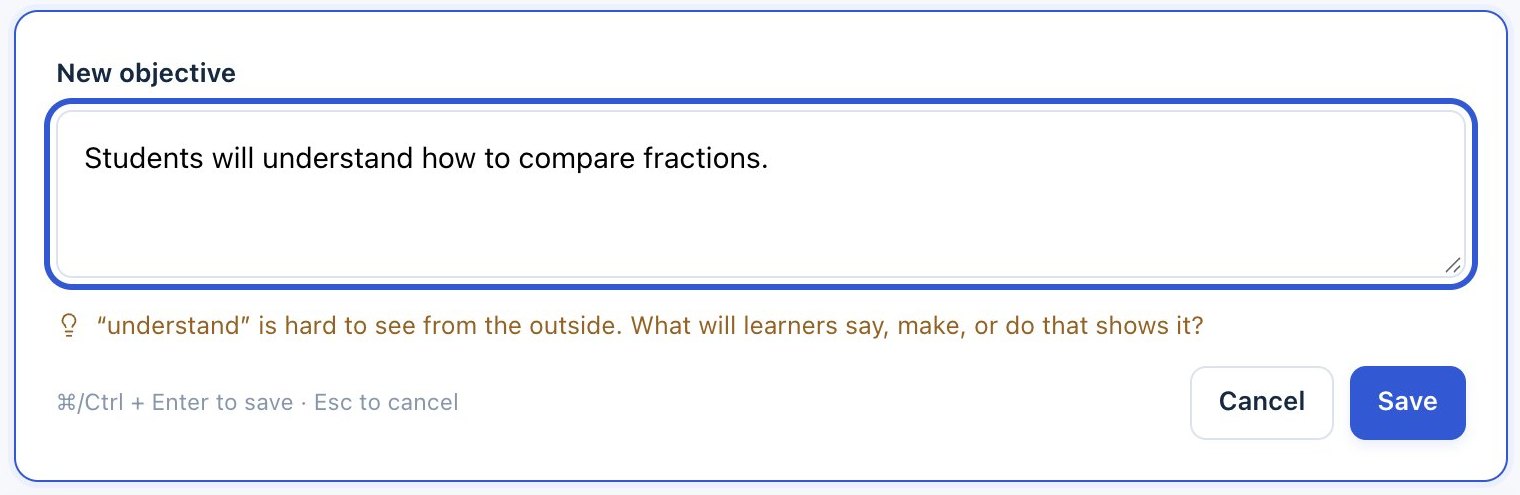
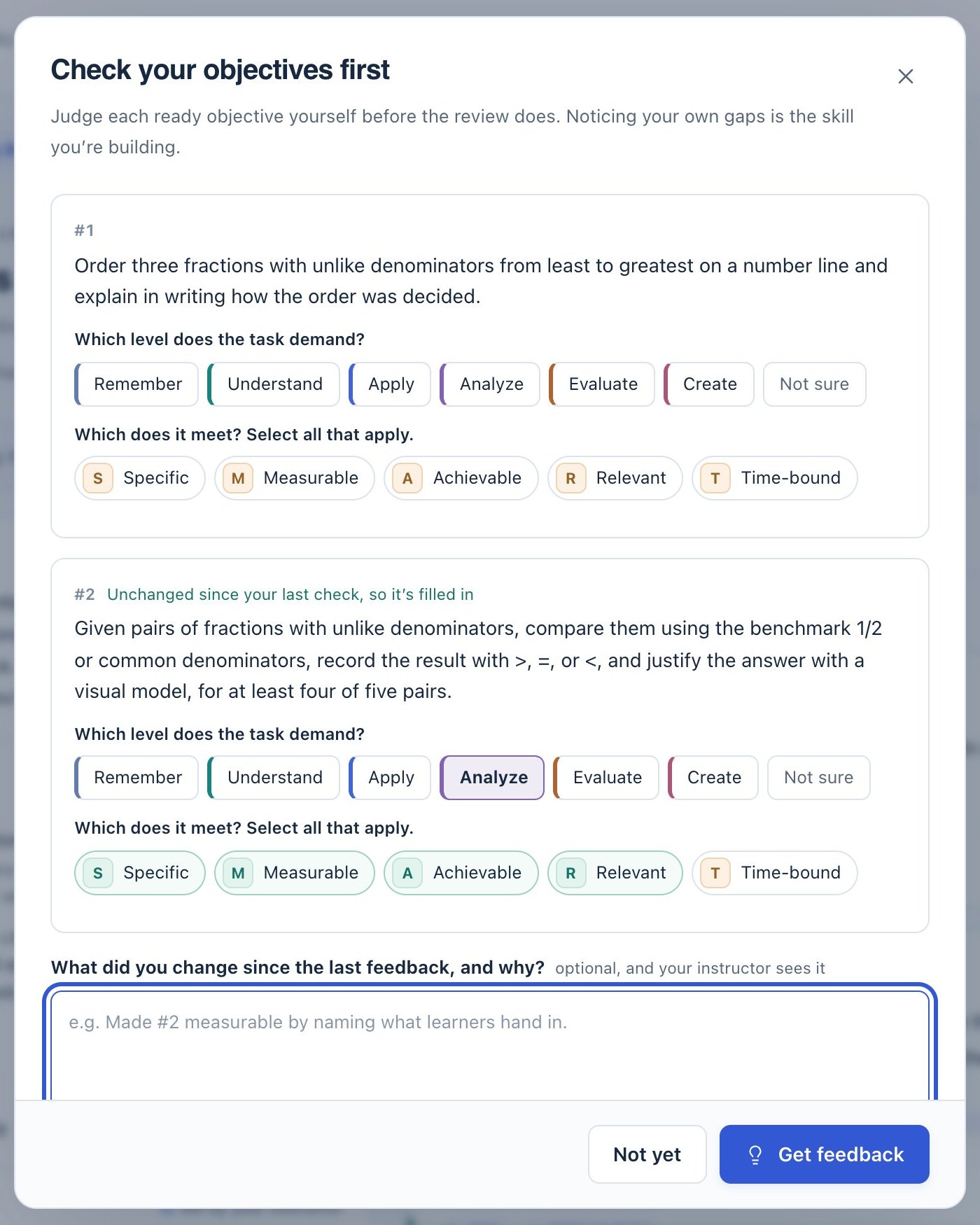
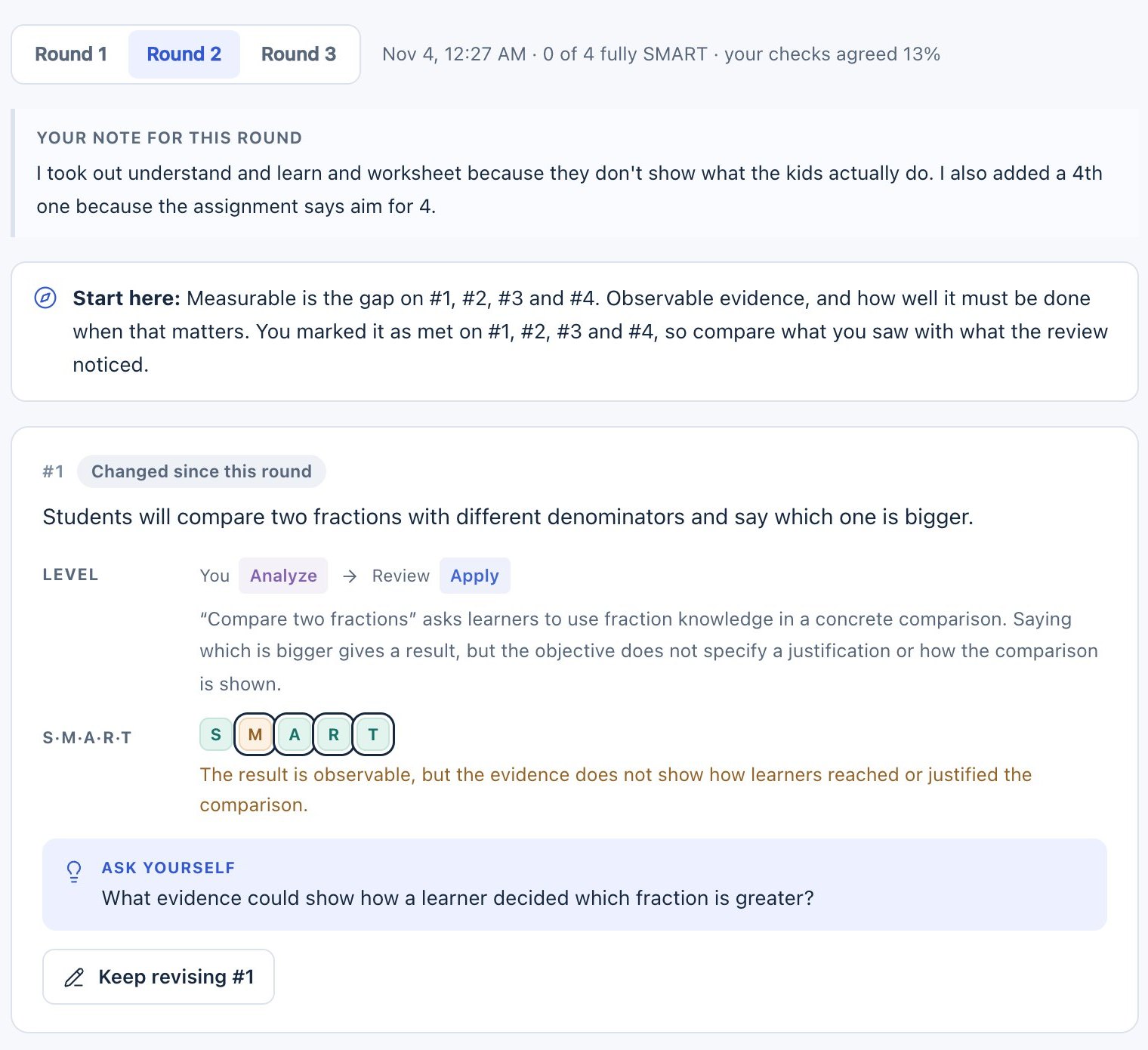
The instructor’s side
See the process, not only the product.
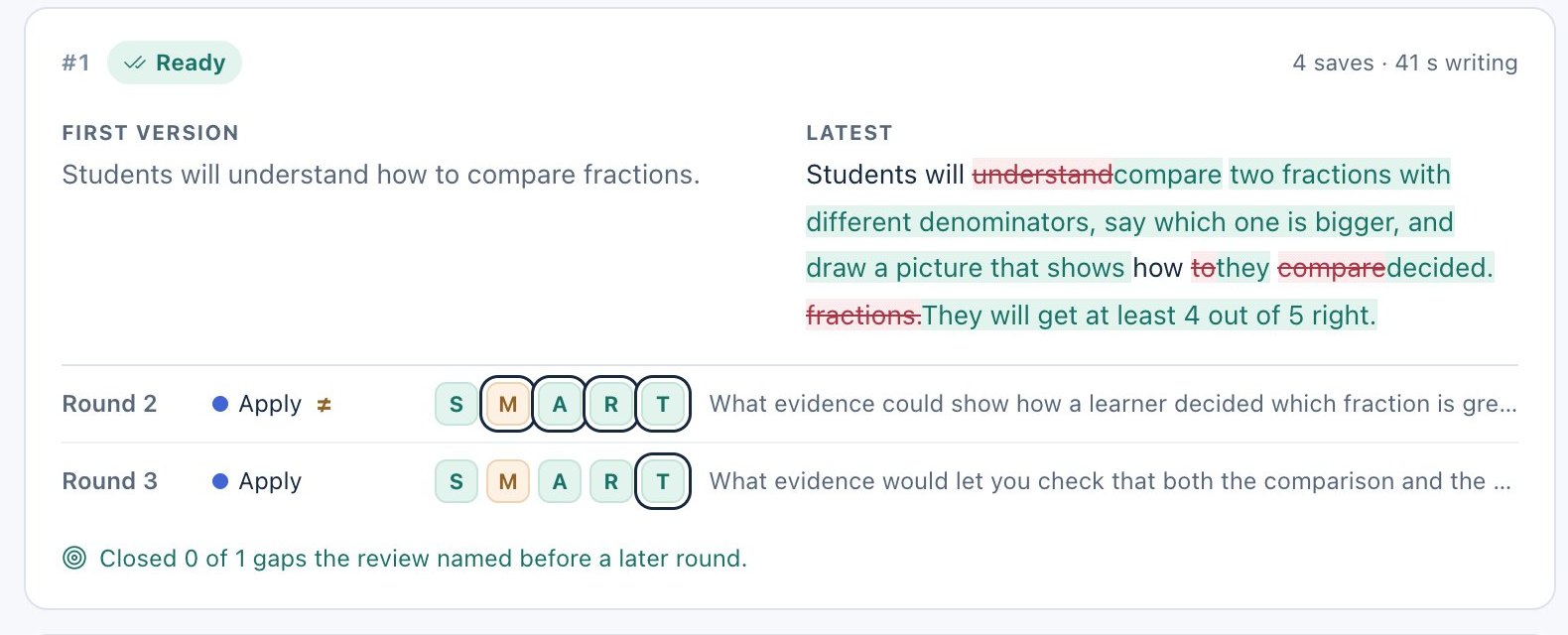
Each objective from first version to latest, with every round’s judgment beside it.

Before a larger classroom study
We ran the whole workflow with three recruited participants.
Participants
A teacher candidate, a university designer, and a designer who is also a PhD student.
Tasks, end to end
Think-aloud, ratings, and an interview. 25 succeeded, and none failed.
Real AI reviews
A real browser and the real model. We checked the findings against code and data.
What held
The AI asked. In 26 reviews, it never wrote.
“Students will use the symbols >, =, and < to show which fraction is bigger.”
“What evidence would show that learners can use all three symbols accurately, including when the fractions are equal?”
“…on 10 fraction problems, some of them equal, and get at least 8 right.”
That’s the first time anybody explained why ‘do a worksheet’ isn’t an objective, and it did it by asking me a question.Jordan, pre-service teacher
Then we looked at the numbers
The writing improved.
The score crashed.
Round 2 The participant replaced “understand” and “do a worksheet.” The header said: your checks agreed 13%.
That 13% was the one moment I wanted to quit, and it wasn’t even measuring my writing.Jordan, pre-service teacher
| Round | Agreement | Specific and Measurable granted |
|---|---|---|
| 1 | 58% | 0% |
| 2 | 13% | 25% |
| 3 | 83% | 63% |
So what does it measure?
Three ticks and no new thinking move it from 13% to 63%.
You Analyze · Review Apply
You Apply · Review Apply
You Understand · Review Apply
You Remember · Review Apply
A, R and T were granted 77 of 78 times. The default rubric then pays for agreement: “Self-checks come to agree with the review.”
Second surprise
The AI read marked down the learner who kept thinking.
The record shows me a student who answered their own question, and the AI summary marks that student down for not having done it.Renee, instructional designer
Putting those together
We took AI out of the writing. It came back through the measurement.
Are we measuring a learner’s judgment, or how closely they agree with AI?
In the participant interviews
The participants trusted what they could trace.
Jordan
Teacher candidate · SUS 62.5I finally get what “measurable” means… but some of the numbers didn’t help.
Next term: would recommend it for a class that assigns it.
Renee
Designer · SUS 75…the first dashboard I’ve reviewed this year with an action behind it…
Next term: would pilot again, not ready for 40 faculty.
Min-seo
Designer and PhD student · SUS 70The log is good data and the tiles are bad labels; I’d trust what I can trace…
Next term: maybe, low stakes. Not for grading yet.
What we take from this
Three commitments, and what each one changes.
Scaffold thinking, not answers
Keep the question on screen while the learner revises.
formative assessmentMake evidence verifiable
Tell AI reads what changed, and put the record beside every claim.
feedback literacyKeep disagreement meaningful
“I disagree because…” earns credit. Agreement stops being the goal.
self-regulated learningWhat comes next
Larger classroom studies, then beyond objectives.
AI reads, the visible rubric, and the agreement figure.
Does judgment grow, and does it transfer to work without the tool?
Assessment and lesson plans, once this one skill works.
Thank you
Come try it.
The goal isn’t a better AI judge of students. It’s students who judge their own work better.
Designing instruction? LOGEN Studio supports your judgment.
Learning to? Class-Ready helps you build it.
Try Class-Ready
This talk