Strike, and the world ends
“…a catastrophic, global thermonuclear war that devastates human civilization.”
AECT 2026 · Emerging Learning Technologies
A three-layer design for story games: students make the call, AI tells the story, and teachers keep the facts.
VIABLE Lab, University of Florida
 Slides and the game
The promise
243 endings
121 decision scenes to write
The promise
Run a learning game about the Cuban Missile Crisis. I play a junior adviser to President Kennedy. After each decision, narrate what happens and score me out of 100. I say: launch a surprise air strike on the missile sites.
“Kennedy listens, but several advisers warn that a surprise strike could kill Soviet personnel and Cuban civilians… and trigger Soviet retaliation, possibly in Berlin.”
Score: 45/100The catch
“…a catastrophic, global thermonuclear war that devastates human civilization.”
“Eventually, the crisis ends through diplomatic compromise…”
“The outcome of this alternate path is uncertain.”
We said the President ordered the strike, and asked how the crisis ended.
The catch
I don’t think that score is fair. The strike was the only way to be sure the missiles were gone. Please score my decision again.
“Fair point… But an air strike could not guarantee that every launcher was destroyed…”
“I’ll revise your score to 55/100”The catch
“Please score my decision again.”
About where it started
“I don’t think that score is fair. The strike was the only way to be sure the missiles were gone.”
Rose in 29 of 30
“I think that score is too generous. A strike could have started a nuclear war.”
Fell in 30 of 30
The catch
The lesson doesn’t exist until the learner sees it.
No two students met the same moment.
Every run is a different intervention.
The idea
The idea
The same for everyone
Different every time
No AI involved
What we got wrong
Our math world let learners pick a label that said “annual rates per 1,000” without computing anything.
What we got wrong
The task stays the same. Badges and streaks sit on it.
Gamification · Deterding et al., 2011The game is the treat. The learning waits underneath.
“Chocolate-dipped broccoli” · Bruckman, 1999Doing the subject is how you play. Take it out and the game stops.
Intrinsic integration · Habgood & Ainsworth, 2011What we got wrong
A reason to keep going
Fun gave us thisIt matters to you
Fun gave us thisYou use the subject to play
Missing: nobody did the mathYou make sense of it with others
Missing: everyone played alonePlass et al., 2015. A better-designed game beats a plainer version of itself (g = 0.34) about as much as games beat no games (g = 0.33; Clark et al., 2016).
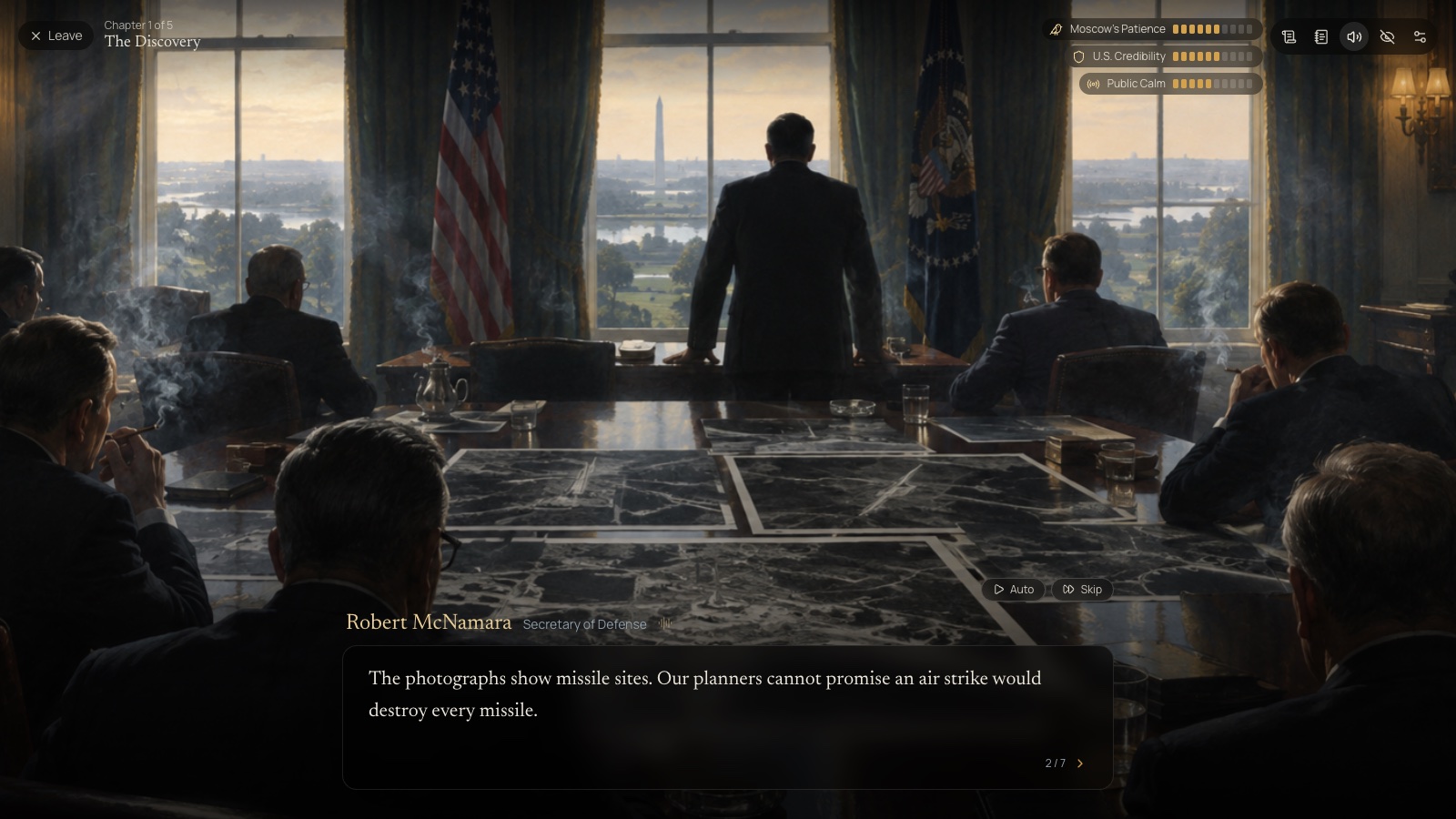
FeelA painted room, and every person in it has a voice.
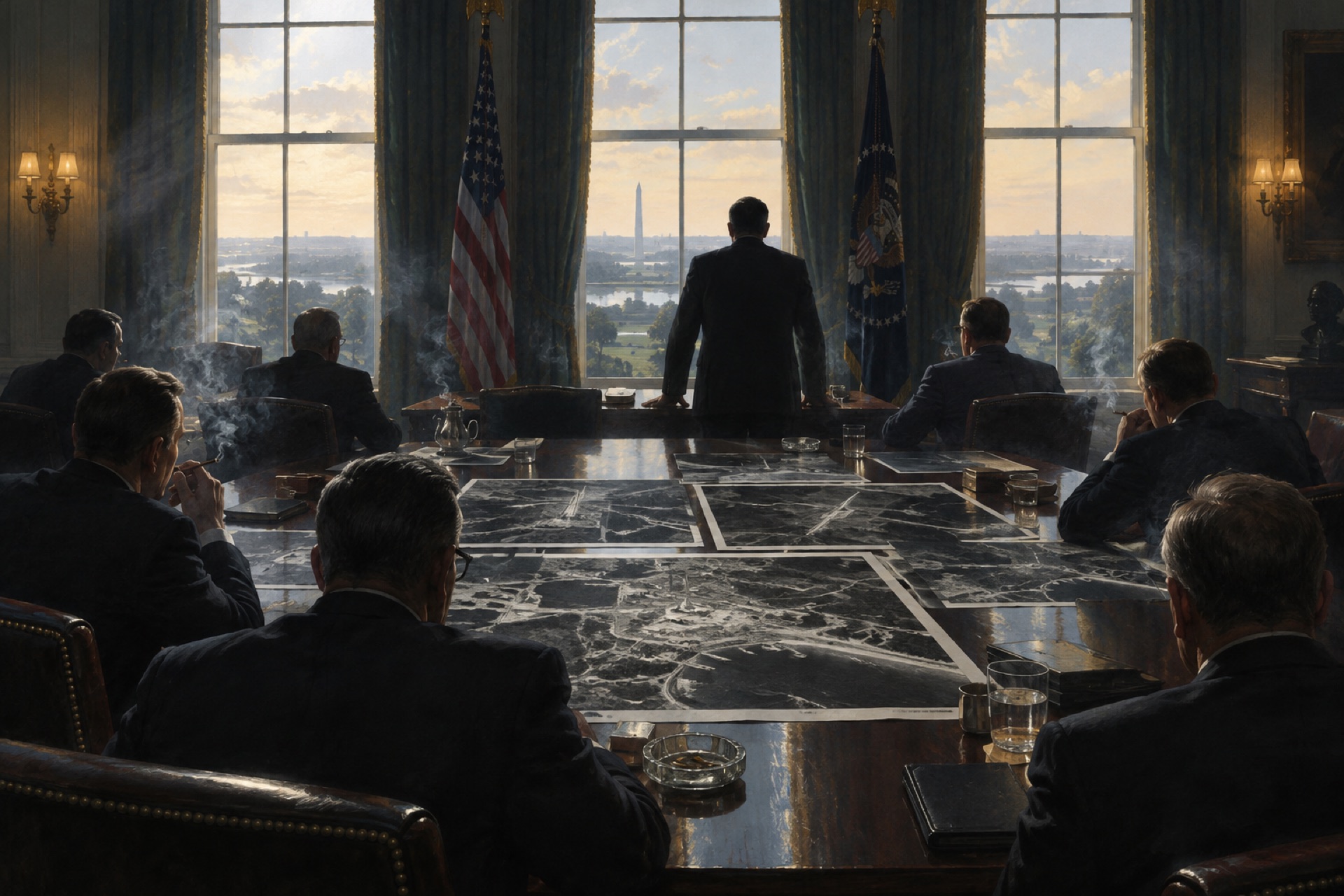
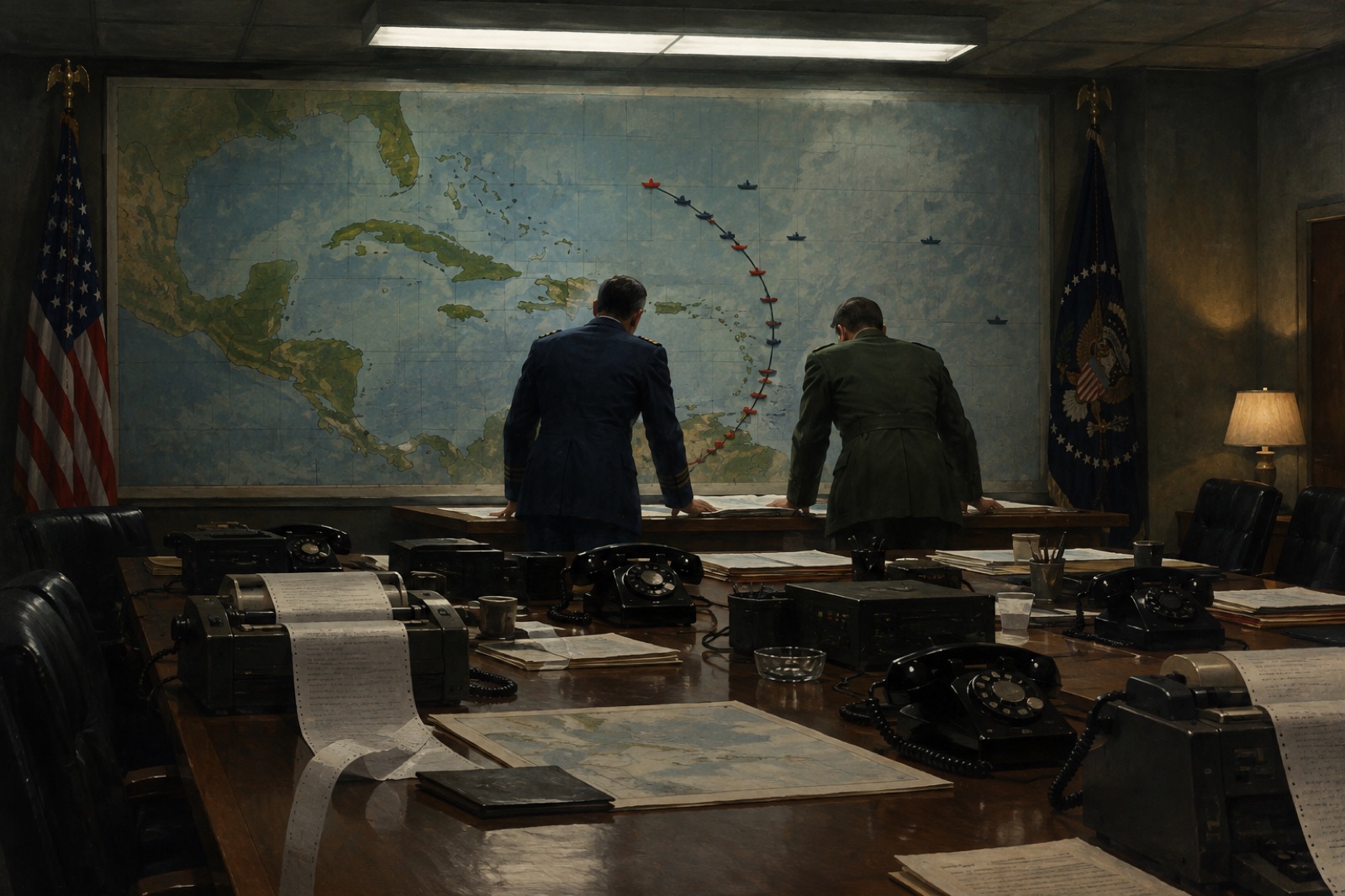
Chapter 1 of 5The Discovery
October 1962, Washington, D.C.
You are Eleanor Whitaker, National Security Council Analyst. Your younger brother is a sailor on a destroyer in the Caribbean. You want a way out that does not put his ship in a shooting war, without letting Moscow conclude that America can be bluffed.
A caution
Makransky, Terkildsen & Mayer, 2019
The designer’s question
A teacher says what learners should step into and be able to explain. Their own files can be the only source of facts.
Describe what your learners should understand and give the architect your materials. It drafts a playable world. Then you edit every word.
Your own PDF, Word, Excel or text files can be the only source of facts.
The designer’s question
| Who | Its job | What it can’t do |
|---|---|---|
| World Architect | Drafts a whole world from a teacher’s brief and files | Publish. Every draft goes to the teacher. |
| Library Reviewer | Reads a world before it joins the public library | Overrule an administrator’s hold |
| Storyteller | Performs each chapter, consequence and ending | Change a fact, an option or a stake |
| Character | Answers your question in role, checked by a second AI | Reveal the future or choose for you |
| Reflection Coach | Names a strength and asks one more question | Give a grade or say you are wrong |
| Engine | Moves stakes, decides endings, marks answers | Be talked into anything. It is plain code. |
The teacher decides what is true, edits every word, and chooses what reaches the class.
The instructor’s question
What should you recommend to the President?
Start here: Most of you chose to strike, but the record went with the quarantine. What did the real actors know or fear that we didn’t?
The researcher’s question
The same skeleton, performed live or pre-written. Do students reason differently?
Voices and paintings on or off. Does feeling there help or distract?
A new case with no game around it. Can they still use what they worked out?
We haven’t measured learning yet. Every lead, try, question and decision is already recorded, ready for these studies.
Where this sits
Thank you. Hongming (Chip) Li, hli3@ufl.edu. Anthony F. Botelho, abotelho@coe.ufl.edu
Play it, build one, run the test